Our ambassador, Max Courtis, reflects on his time in South Africa with GWRI.
Before arriving in Johannesburg, I had completely underestimated the scale of GWRI.
I pictured a programme supporting perhaps one or two girls’ teams. Maybe 100 young people at most. What I found was completely different. Across Gauteng and KwaZulu-Natal, GWRI’s network of coaches, schools and clubs reaches around 50,000 boys and girls through rugby.
A day with the All Blacks and Black Ferns
My introduction to it all came on a pretty extraordinary day.
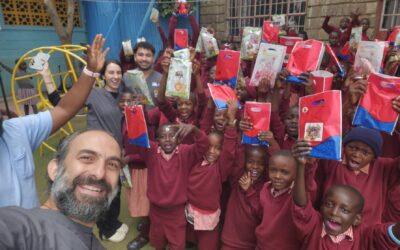
The All Blacks and Black Ferns joined a GWRI training session during their time in South Africa. From the moment the children arrived, you could see what the occasion meant to them. Players were signing boots and jerseys, adidas kit was being handed out and the children sang as they welcomed some of the biggest names in world rugby onto their pitch.
Then the rain came.
What looked like it might ruin the session actually created one of my favourite moments of the whole trip. Everyone moved inside and the children suddenly had the chance to sit down and ask the players questions.
The conversation quickly moved beyond rugby. They spoke about pressure, setbacks, difficult moments and how they deal with challenges in their own lives. There were proper, thoughtful answers to questions from kids who would usually only ever see these players on television.
The session eventually finished with a Māori song, sung to a room full of young South African rugby players.
It was an amazing day. But once the New Zealand players left Johannesburg, I wanted to know what happened next. What does rugby look like when the international teams, cameras and excitement have gone?
That was when I properly began to understand GWRI.
Where the programme begins: the schools
At one primary school, I arrived to see roughly 100 children crowded around the edge of the playground while a much smaller group played touch in the middle. It felt like the whole school knew the rugby session was happening.
For me, that scene summed up two sides of the programme straight away. You could see how much the kids wanted to be involved, but also how much room there still is to grow. There were far more children standing around wanting to play than there were places in the session.
It was also where I started meeting some of the young people who had first found rugby through GWRI’s work in schools.
Trust, a player from Hulwazi School, told me that before rugby there simply wasn’t much for him to do.
“I had no activity to do. Rugby builds me and I keep learning new things here.”
For him, rugby has already taken him far beyond the school playground.
“Rugby has introduced me to many places, and I thank God for that.”
When we spoke about where it all started, he described the school where he began playing as the place where something clicked.
“That school is where I made my breakthrough. Playing rugby, I felt like this is the place for me. Rugby introduced me to that feeling.”
I spent part of the day walking with players like Trust along the same routes they take between school, home and rugby. For some of the kids, those journeys can take more than an hour.
Trust was very open about Daveyton.
“Daveyton is filled with everything. There are good things, but there’s crime. To fulfil their addictions, they steal. It’s a crime-filled place.”
Driving through these communities, you begin to understand what he means. There are huge areas of township housing, and from the outside there often doesn’t seem to be an obvious abundance of things for young people to do.
And then, tucked within all of that, you find these rugby sessions.
The people who keep turning up
Over the following days, I travelled around with the coaches who make them happen every week. That was where I properly got to know people like Tebogo and Jaco.
What stood out was how normal all of this seemed to them. They have spent years helping young people through rugby and, even while dealing with challenges in their own lives, they keep turning up. They were constantly talking about the kids, the coaches and where different players might be able to go next.
There was never a feeling that any of it was being done for recognition. It felt much more like rugby had given something to them, and giving that back to someone else was simply what you were supposed to do.
Jaco told me one of the reasons GWRI began was because of the gap he saw in the game.
“There was a big gap between men’s and women’s rugby, and the development.”
But what I found interesting was that producing elite players isn’t really how he measures success.
“The bigger prize is where the girls give back to the community and teach the game to the masses. We’ve created that platform for the girls to get educated and give back.”
More than finding the next Springbok
That idea came up again and again during the trip. GWRI is not simply trying to find the next Springbok.
Of course, having someone make it to that level matters. If a young player from a place like Daveyton sees somebody with a similar background reach provincial or international rugby, suddenly that pathway feels a little more real.
But the bigger cycle is what happens when players become coaches, mentors and role models themselves, then go back into their own communities and bring more young people into the game.
Temperance is a great example. She became the first female township team manager, and when I asked why she had taken that role on, her answer was very simple.
“I didn’t want them out there on the street. My goal was to develop them. One day I wanted to see them playing professional rugby.”
For young women in particular, having people like that to look up to matters.
I met Oratile, who also first discovered rugby through GWRI’s school programme. She told me she looks up to Siya Kolisi, not just because of what he has achieved as a player, but because of the kind of person he is and what he represents to her. Her message to other young players was even simpler:
“Never give up. Even though the journey is hard, never give up.”
Then I spoke to her mum. When rugby was first introduced at the school, she said she “wanted to cry” at the thought of her daughter playing it. Now, after seeing what the sport has given Oratile, she feels completely differently.
This was a pretty stark reminder that success here doesn’t have to mean producing a professional rugby player. Sometimes it is simply a girl realising there is a sport she belongs in. For another GWRI player, rugby had become something even more personal.
“I play rugby because it’s a form of therapy for me.”
Some of the young people GWRI works with have come through extremely difficult circumstances. There are stories of abuse, instability and trauma within the programme that are hard to hear. But spending time there, what I kept noticing was where those stories could go next.
A girl can arrive needing somewhere safe to be, then become a player. A player can become a coach. A coach can become the person who introduces another group of kids to rugby for the first time.
Later in the trip, I watched a group of boys preparing for a regional tournament. Some were training without boots. They didn’t have the facilities or amount of training time that many of the teams they would eventually come up against would have, but they were going anyway. For some of them, playing in that environment could mean being seen by coaches from larger schools or rugby programmes and opening another door.
There was pressure behind what they were trying to achieve, but watching the session, you wouldn’t necessarily know it. There was still so much laughing, messing around and enjoying rugby with their mates.
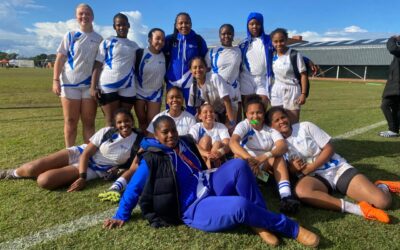
On my final day, I returned to one of the girls’ sessions. Many were now training in the adidas kit and boots they had received during the New Zealand visit. Some still had the players’ signatures written across them.
A few days earlier, those boots had been signed by All Blacks and Black Ferns. Now they were being worn through another normal training session. I thought that was a nice reminder that the impact of a visit like that does not necessarily disappear when the team bus leaves. The kids will remember meeting those players for years.
Who is still there the next morning
But the bigger thing I took away from Johannesburg was understanding who is still there the next morning. It’s Tebogo, Jaco, Temperance and the other coaches and volunteers who keep turning up.
Before the trip, I had imagined a few teams of girls playing rugby. Instead, I found a network reaching around 50,000 boys and girls across Gauteng and KwaZulu-Natal.
And what surprised me most was how many different things “impact” could actually mean.
For Trust, rugby gave him somewhere he felt he belonged and introduced him to places he might otherwise never have seen. For Oratile, it gave her a sport, a role model and something to keep working towards. For her mum, it completely changed the way she saw her daughter playing rugby. For another player, it was therapy. And for people like Jaco, Tebogo and Temperance, rugby has become something they can keep passing on to the next person.